

The dangers of the Internet for our children and teenagers #1
Italian brainrot: what is behind these videos that fascinate children?
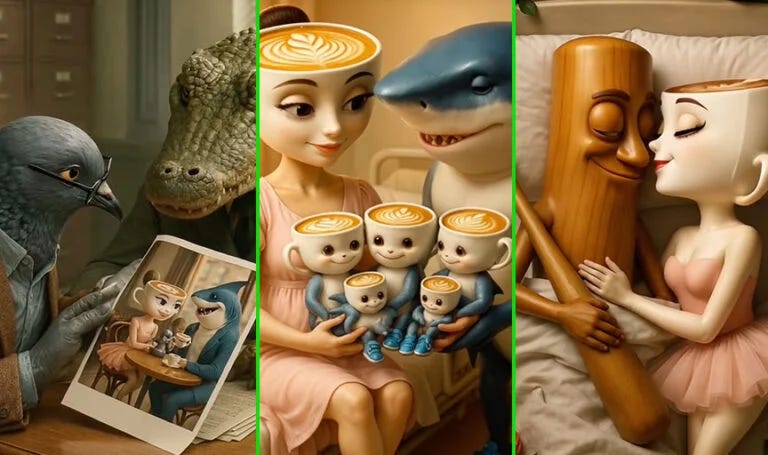
You may have already heard your child repeating "Tralalero Tralala." They might have told you about Ballerina Cappuccina or shown you, laughing, a shark wearing sneakers.
These characters belong to Italian brainrot, a trend that has become very popular among children. Their world seems mostly absurd and funny. Yet, some videos can contain messages that are far less childlike.
To decide what we want to authorize, limit, or prohibit, we must first understand what attracts our children.
What is Italian brainrot?
Italian brainrot refers to images and videos that feature improbable characters. They are often created with artificial intelligence and have Italian-sounding names.
These characters mix animals, objects, or food. They are accompanied by artificial voices, repetitive songs, and absurd stories.
Italian brainrot belongs to a broader phenomenon called "brain rot." This term refers to very short, repetitive digital content that is easy to watch continuously.
Why does Italian brainrot fascinate children?
These videos attract children primarily through their absurdity. Faced with a shark wearing sneakers or a ballerina with a cup for a head, the child discovers something unexpected.
The sounds and names are also easy to remember. They can quickly become shared references among friends. Children repeat them, draw them, and sometimes invent their own characters.
Italian brainrot thus becomes a game and a common language. It also allows children to share a universe that adults do not always understand.
Content that is not always suitable for children
With their bright colors and funny shapes, these characters seem designed for the youngest ones. Yet, their appearance says nothing about the lyrics or stories that accompany them.
Some original content includes insults or violent scenes. The trend was then picked up by many creators. Some versions have become lighter. Others still feature violence, humiliation, or toxic relationships.
The same character can therefore appear in a funny video, then in content that is much less suitable. The child may also memorize a song and repeat it without understanding the lyrics.
Short videos and attention: what do the studies say?
To date, no study has measured the specific effects of Italian brainrot on children. Therefore, there is no evidence to claim that these characters "destroy the brain."
Researchers are more interested in the format of these videos. They are very short and follow one another rapidly. The child thus goes from one sound or story to another without a real break.
A study published in 2025 in the journal Psychological Bulletin gathered the results of 71 studies involving nearly 100,000 people. It shows that high consumption of short videos is associated with greater attention difficulties.
Another study conducted on 528 children aged 6 to 12 reached a similar conclusion. Inattentive behaviors were more frequent in children who watched more short videos. This association was even more pronounced in younger children.
These results show a link, but do not prove that short videos are the sole cause of the observed difficulties. The problem therefore does not come from an absurd character watched occasionally. It appears primarily when videos accumulate and the child struggles to stop watching them.
How to protect your child from Italian brainrot?
The goal is neither to trivialize this content nor to give in to panic. The objective is to observe your child's habits in order to set appropriate limits.
You can start by asking them to show you their favorite characters. Invite them to explain what they find funny. You can then check together the meaning of the songs or lyrics they are repeating.
This discussion allows you to discover their world. It also helps them to take a step back from content they sometimes watch without questioning it.
Then observe the role these videos play in their daily life. Are they able to stop easily? Does watching them disrupt their sleep, homework, or family time? Has any content ever shocked or made them uncomfortable?
These answers will help you choose the framework you feel is most appropriate. Some digital content can be discovered at home, on a shared screen, and at chosen times. The parent thus remains available to answer questions and intervene if necessary. However, the child does not need to have access to it everywhere and at all times from their phone.
Trends and characters will change. The good habits will remain the same: understand what your child is watching, discuss it with them, and set limits when it becomes necessary.
Why we chose responsible geolocation for The Phone Géo
Pronote sur le téléphone de son enfant : est-ce vraiment une bonne idée ?